

‘I built a mini wind turbine that spins in time with real British wind farms’
How do you visualise what the energy system is up to? Make some models!

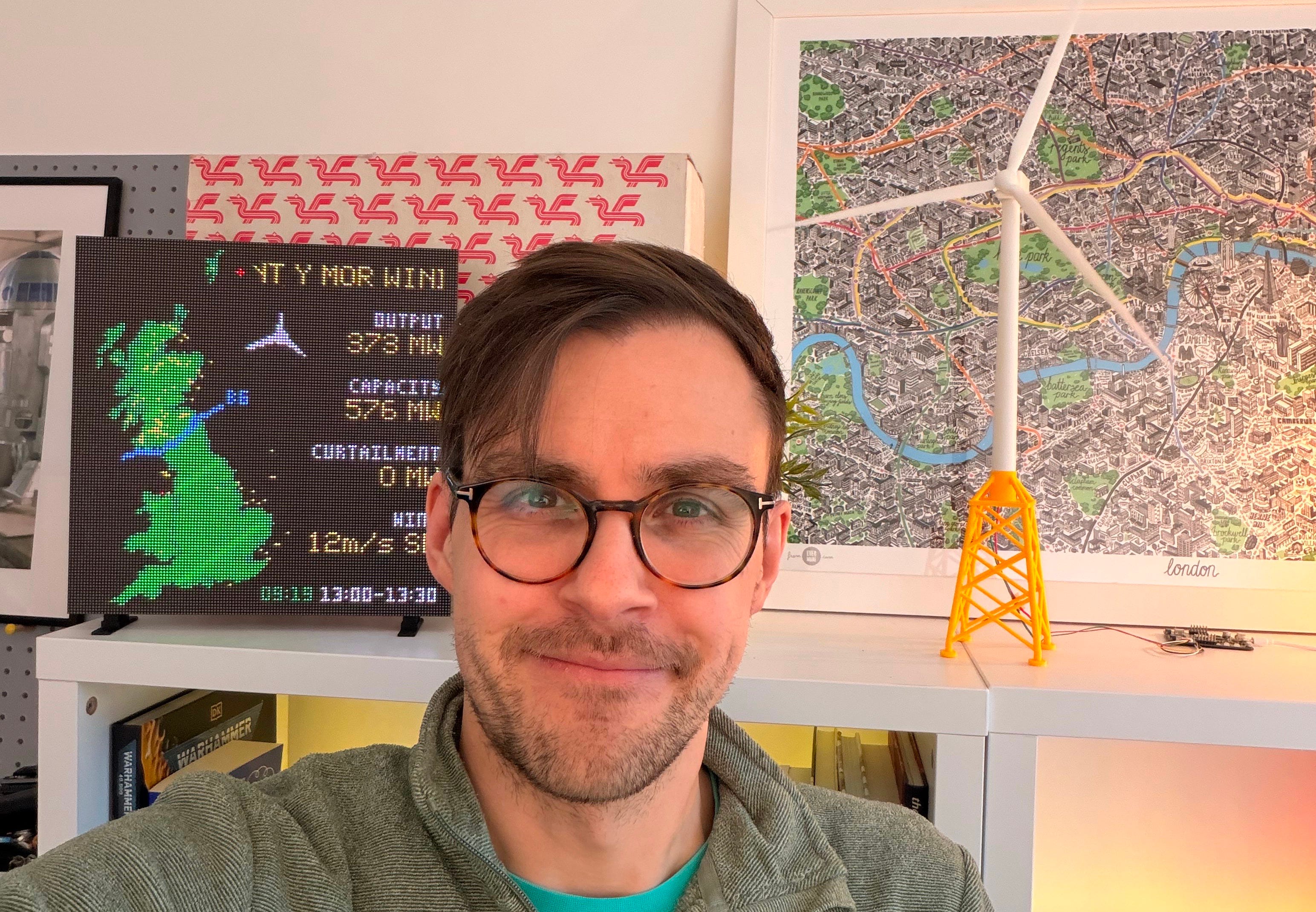
The Christmas feasting was over. There was nothing on the telly. And days left before he had to go back to work. Robin Hawkes looked around at the pile of electronics he had bought for the project he’d long put off and decided: “Now’s the time.”
His plan? To build a model wind turbine whose blades would spin at speeds that match the workings of real British wind farms.
The thing about energy systems is that what they’re doing from moment to moment can be difficult to visualise. We have all seen a wind turbine spinning – but how does that spinning speed up, slow down and stop over time? Plus, electricity grids are just dull-looking giant cables and grey boxes, stuffed full of invisible electrons. If you could see what’s actually happening in such a system with your own eyes, it might bring all of it to life.
Hawkes, who works for Octopus Energy, an energy firm, already had the data. His website, GB Renewables Map, plots live information about wind activity and the output of British wind farms.
As I write this, I can see from the site that strong winds are blowing from the west right over the North Sea and Britain, too. The UK’s two most powerful offshore wind farms, Hornsea 1 and 2, in the sea off Hull, are each generating more than a gigawatt of electricity.
‘Tiny little motor’
“I wanted to combine electronics and [data] to show what’s happening on the grid,” says Hawkes. He fired up his 3D printer, which soon churned out a model of an offshore wind turbine, which Hawkes then modified so that the three delicate blades could turn on an axle. “I did some customisations to fit a tiny little motor in the top,” he recalls.
A Raspberry Pi device takes data from a real wind farm of choice and then works out how quickly the real turbine blades at that farm would be spinning. Hawkes says the estimated rotation speed is not 100% accurate but that, when applied to the model turbine, the dinky device’s spin should roughly match what you would see if you were looking at one of the giant turbines on the real wind farm.
It’s a way of bringing what is happening out there, on the windy seas, into his rather more comfortable home office.
“I’ve since added a feature that lets you control it from a phone, you can scroll through a list of wind farms and press ‘OK’,” says Hawkes. “The model will update.”
Hawkes did not stop there. He also made “Ceefax for wind farms” – a pixelated display board that can sit beside the mini turbine. It shows which wind farm the model is currently mirroring, the wind speed at that location, and the wind farm’s actual power output. (For those who don’t know, Ceefax was a teletext-based information service from the BBC that people could access via their TV screens. It was a bit like having the internet on your telly, without all the horrible trolling. Maybe we should bring it back?)
The setup helps to reveal the impact of curtailment, when wind farms are slowed down or prevented from operating due to an excess of electricity on the national grid. “That’s an area I’ve done a lot of analysis in, both personally and at work,” says Hawkes. Having a visual representation of curtailment right in front of him is “incredibly useful” he adds.
Model energy village
Hawkes’ project got me thinking. I wonder whether railway modellers or other hobbyists would like to have wind turbines in their layouts, which match actual wind farm activity?
And why stop at wind energy. You could in theory have a couple of water tanks, one above the other, that slosh water between them to show the current operations of a pumped hydro plant. Or a fish tank – mercifully, without any fish – that has a mini wave machine to imitate tidal power. (If you have any suggestions, put them in the comments below!)
Solar might be trickier. Hawkes suggests a tiny solar panel that angles itself towards the sun throughout the day while I come up with the concept of a lamp, the brightness of which matches current solar farm output.

The latter idea was inspired by a BBC News story published at the start of the year, which visualised how solar energy contributions to Great Britain’s grid have grown over time. A ball-shaped, sun-like graphic depicts the days of the year – fatter in the middle because summer days are longer. The ball’s constituent yellow and orange lines are faint in 2013, when there were far fewer solar panels around, but they have become rich in colour by 2025.
First though, Hawkes has plenty more ideas to implement around wind turbines. For one thing, he is considering releasing the code and plans for his mini version of the machines. “It would be a shame if this is only something I can use,” he says. Recently, he bought some LEDs to see if he can add realistic aircraft warning lights to the top of his model. And, he has plans to print more of the devices, to represent a variety of different turbine designs.
I suggest that, before long, he might be surrounded by mini turbines all merrily spinning. “One hundred percent, that’s what going to happen,” he says. “I can already see it.”
Further reading on this week’s story
Visualising changing energy systems is actually incredibly fashionable, you know. There are lots of outlets that produce brilliant material in this vein. Try MyGridGB, Our World in Data, energy think tank Ember, Boston University’s Institute for Global Sustainability, or the European Union’s own energy visualizer, to name a few.
Curtailment of wind farms is a growing issue. This great blog from the UK Energy Research Centre explains what curtailment is – and why it is so costly.
Update: Added a brief explanation of the phenomenon that was Ceefax.
Thanks for reading! If you enjoyed this story, don’t forget to share it with your friends and colleagues. You can also subscribe to The Reengineer and follow me on Bluesky.
Many of the turbine blades for those wind farms including the largest ones are made in Hull at a huge factory at which the ships carrying them can dock and take the blades out to the farms. Search Siemens Hull