


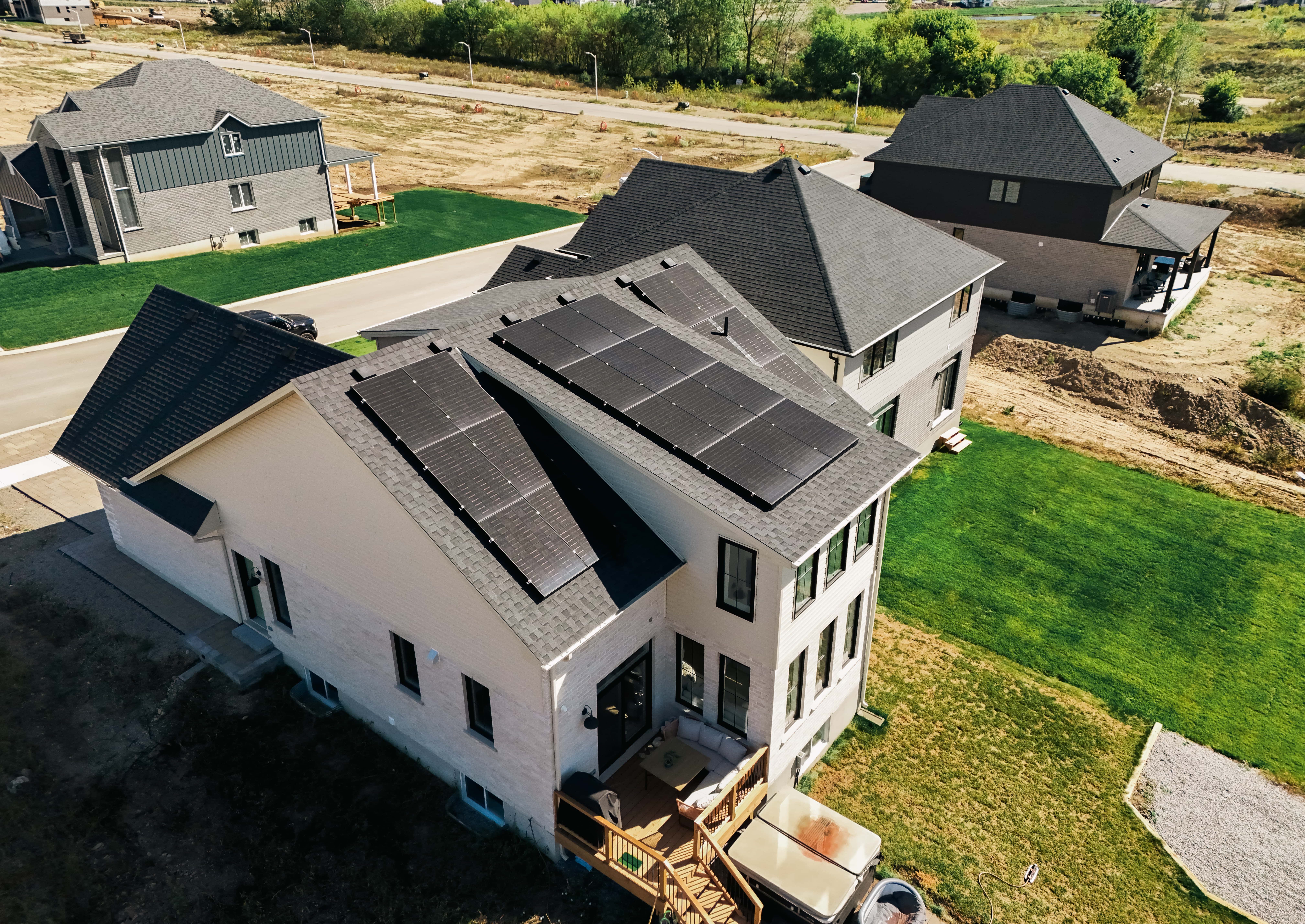
On a street in Ontario, Canada are two households – both alike in floorplan. But very different in how they run. One of these detached properties has natural gas-fired heating and uses grid electricity while the other is fully electrified: kitted out with solar panels, a heat pump and a thermal battery.
“This is my own home,” says Jaime Crncich, an entrepreneur in her twenties who is president of Magnus Homes, a Canadian house-building firm.
While planning the construction of the house, which is part of a new development built by her company, she decided to collaborate with researchers at Western University who sought to monitor the energy efficiency of the building in real-time. The project was paid for by multiple parties involved.
“I thought this was a good opportunity to try this technology,” says Crncich. Across the street, her company built an almost identical property with the same floorplan, meaning that the Western University researchers can compare how the two buildings perform over time.
Preliminary results suggest that the electric house has 55% lower carbon emissions, and 45% lower bills than the house over the road – though the researchers stress that this data relates only to the late spring and summer period.
In Canada, natural gas is cheap, heat pumps are less common than in the US, and winters are long and cold – dipping even to -20C in southern Ontario, a stretch of the province that borders the US states of Michigan and New York. As Canada attempts to transition away from fossil fuels towards net zero, many homeowners still have big questions about how it’s all going to work for them.
A hard sell?
Effectively, Crncich is using her own house as a demonstration project – which Western University describes as a first-of-its-kind in this part of the world. While some homeowners are already embracing clean energy tech, Crncich says the market more broadly is far from clamouring for it: “I don’t know that I would find a customer interested in putting this type of technology in their own home.”
She points out that regulations, and consumer demands, are ultimately the chief drivers behind what the house-building industry does and how it does it. “We are striving to reach higher than what’s currently code-required [demanded by regulations] right now.” Magnus Homes, founded in 2020, has built 67 homes to date.
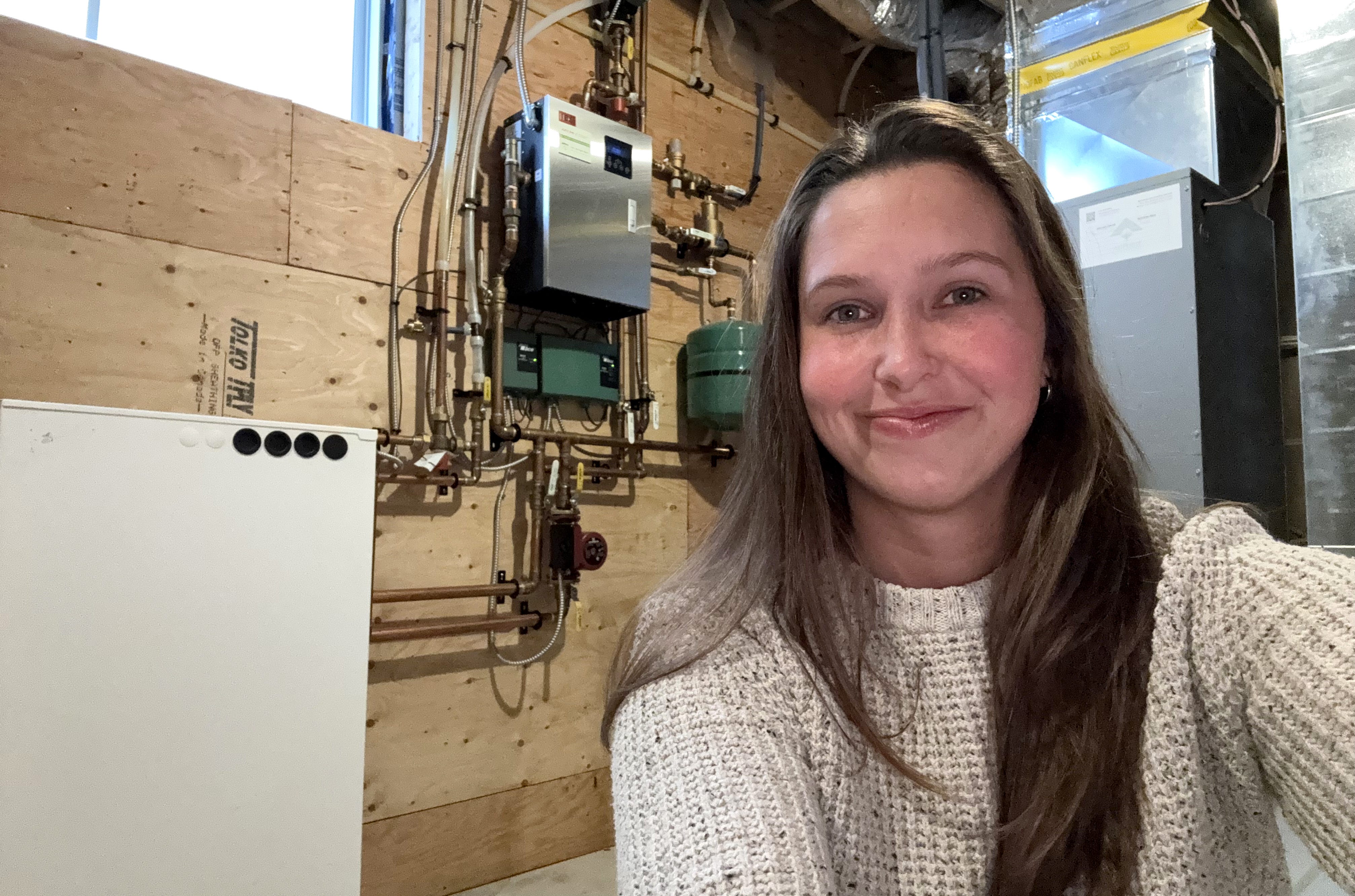
Crncich moved into her new abode back in March. Now, the first snow is falling in this part of Ontario and the researchers are keen to see how the house performs during its first Canadian winter.
Besides a basement bristling with energy tech, the building is also highly insulated – with triple glazing and insulation in the walls, floor and loft. That includes wall insulation made of rigid foam, and blown-in attic insulation. So far, it’s all working as planned. “There’s plenty of hot water on demand quickly, the house is comfortable, the system is quiet,” says Crncich.
Joshua Pearce at Western University says the house has a 10-kilowatt solar array. This is bigger than most UK rooftop solar installations but the team sought as much energy as possible to power the thermal battery. They decided not to go bigger than 10 kilowatts due to Canadian regulations, which require additional red tape for installations that exceed this capacity.
‘Magic’ battery
“The magic of why this was possible in Canada was the thermal battery, which actually comes from the UK,” he adds. It’s a Sunamp Thermino, which Pearce suggests may be the first one ever installed in Canada.
The device relies on a salt-based phase change material, which is a bit like a wax that melts when warm, and solidifies evenly into a crystalline structure as it cools. When sun hits the solar panels, Pearce explains, you use the electricity generated to melt as much of the salt-based mixture inside the thermal battery as possible. Its molten form retains heat for many hours. The next morning, when someone wants a shower before the sun is up, it’s that stored heat that warms the water for them.
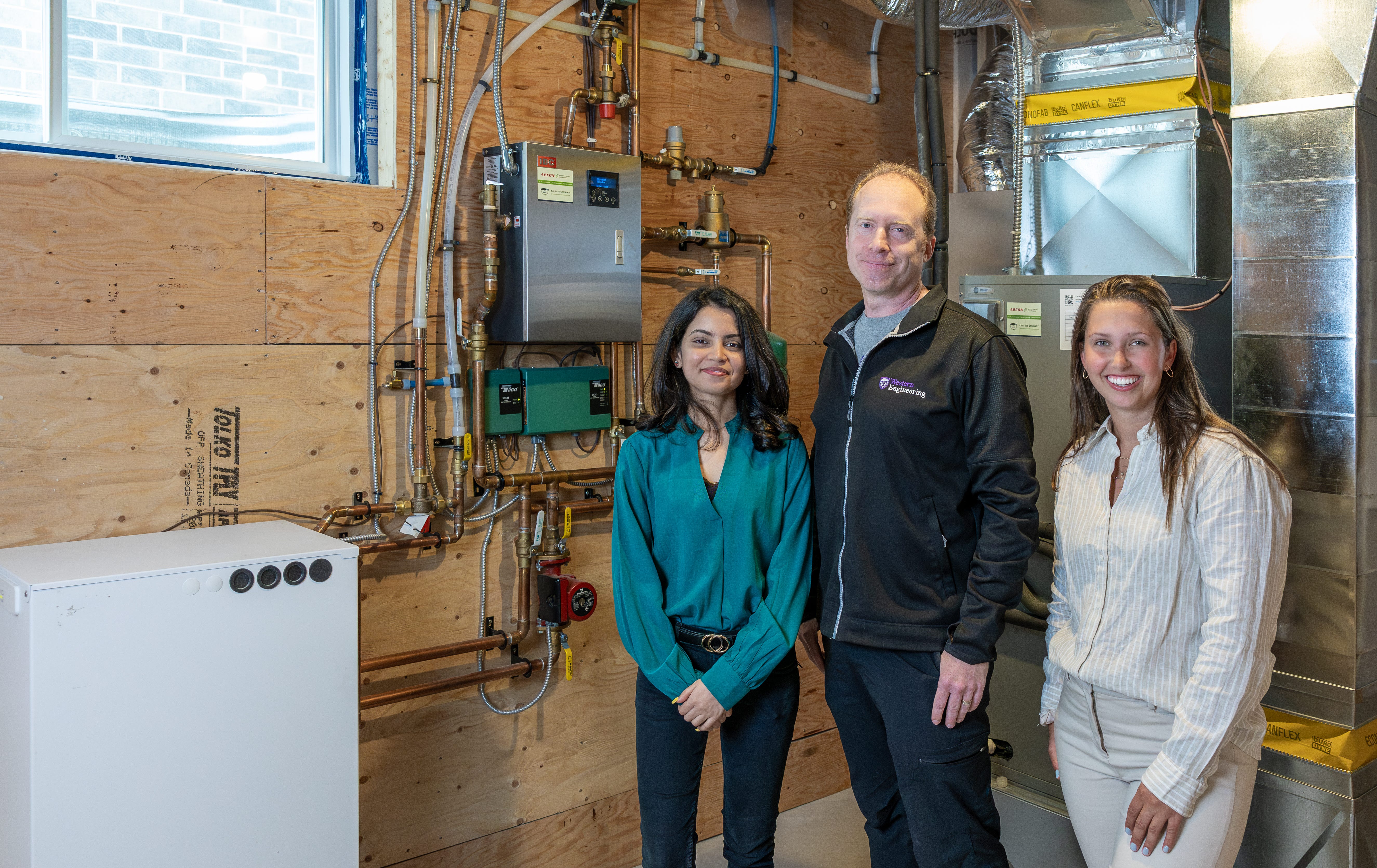
The university team has designed data loggers to monitor weather conditions, and they also have other equipment that tracks how appliances in Crncich’s home run. “The early result is very promising,” says Shafquat Rana, a PhD candidate at Western University.
Crncich adds, “My bills have been comparable to previous homes.” And she likes the idea that the property is “future-proofed” against the possible phasing-out of natural gas.
There are many similarly designed properties in other countries – notably some here in the UK, which are exceeding performance expectations. But Pearce stresses that the technologies used here, especially heat pumps, are still far from widespread in Canada.
‘Money on the table’
“It’s remarkably difficult to get heat pumps,” he says. Some Canadian provinces, such as Alberta, have extremely low natural gas prices, which means it may be harder for homeowners to justify installing heat pumps from an economic perspective. “For Ontario, where this house is, heat pump economics are just very marginal, a couple of percent return.”
But the plummeting price of solar panels has “changed the equation”, he adds, meaning that when solar is used in a system like this, in conjunction with electric-powered heating devices, they may facilitate a move away from fossil fuels. Today, homes that don’t have solar are “leaving money on the table”, argues Pearce.
The first full winter test of Crncich’s home is still just getting underway, though. The house does have a backup electrical boiler just in case. Proof of how well everything functions will come in the form of data – and Crncich’s own experience.
“I like to take a bit of risk and to try something new. And I thought this was the perfect opportunity,” says Crncich. “It’s exciting and fun.”
Further reading on this week’s story
This week, I wrote a story for The Guardian about highly energy efficient homes in Handsworth, Birmingham.
The OECD, an intergovernmental organisation, has a working paper on Canada’s net zero transition with lots of details about the country’s policies in this area.
Heat pump economics in parts of Canada appear to contrast with those in Alaska, where – as I wrote in 2023 – skyrocketing oil prices have pushed some homeowners towards heat pumps.
Thanks for reading! If you enjoyed this story, don’t forget to share it with your friends and colleagues. You can also subscribe to The Reengineer and follow me on Bluesky.